
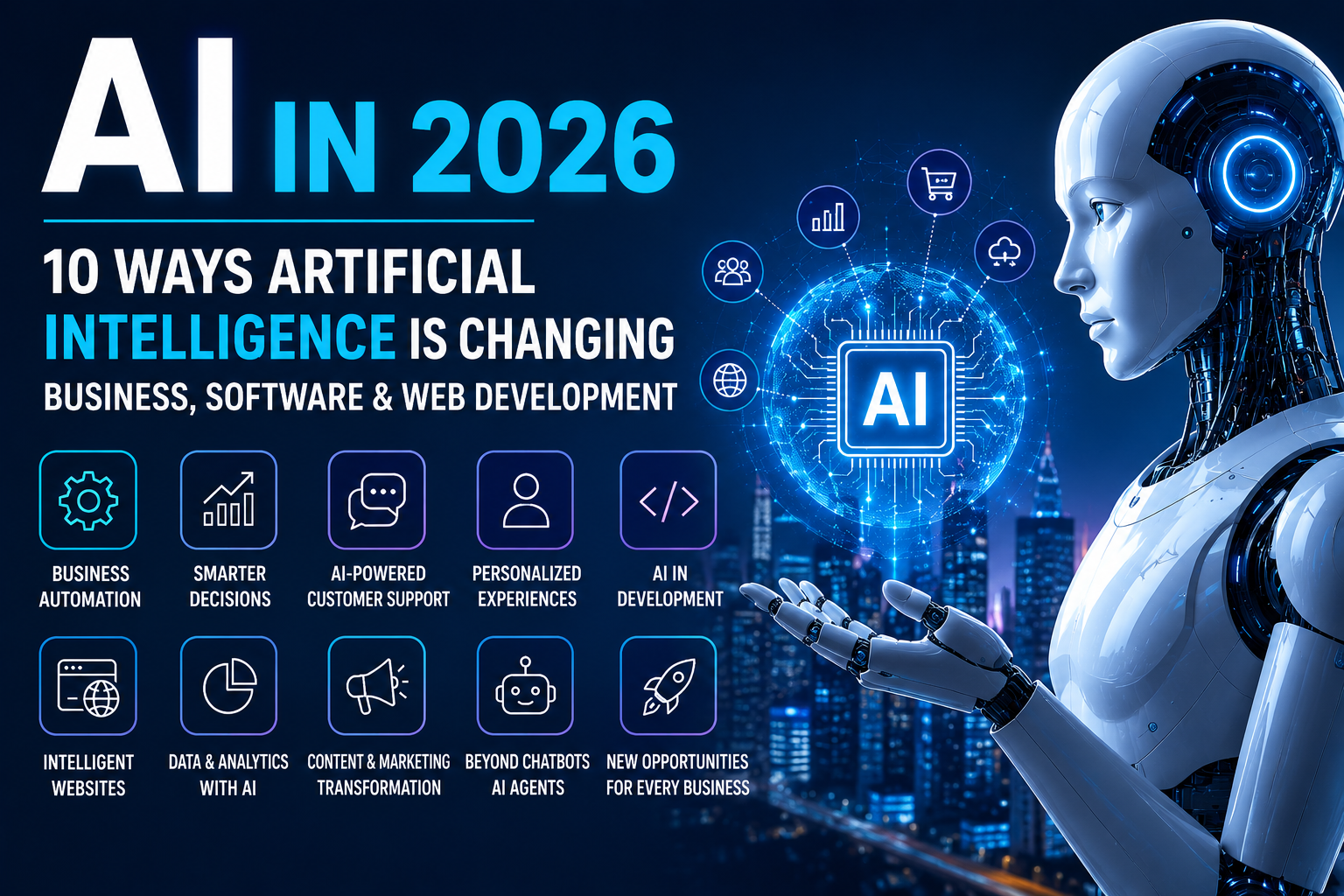
Artificial Intelligence (AI) is no longer a technology limited to research labs or large technology companies. In 2026, AI is becoming a practical part of how businesses operate, software is developed, websites are designed, and customers interact with digital products.
From AI-powered customer support and business automation to intelligent software development and personalized websites, artificial intelligence is changing the digital landscape at a remarkable pace.
For startups, small businesses, enterprises, and technology professionals, understanding these changes is becoming increasingly important.
In this article, we explore 10 major ways AI is changing business, software development, and web development in 2026, along with what these trends could mean for the future.
Artificial Intelligence refers to technologies that enable computer systems to perform tasks that normally require human intelligence.
What Is Artificial Intelligence?
These tasks can include:
- Understanding language
- Analyzing information
- Recognizing patterns
- Generating content
- Making predictions
- Automating repetitive tasks
- Understanding images and documents
- Assisting with decision-making
- Generating and analyzing code
Modern AI systems are increasingly capable of working across multiple types of information, including text, images, audio, video, and software code.
This evolution is helping businesses move from simple automation toward intelligent automation.
10 Ways AI Is Changing Business, Software & Web Development in 2026
1. AI Is Automating Repetitive Business Tasks
One of the biggest impacts of AI is the automation of repetitive work.
Businesses traditionally spend significant amounts of time handling tasks such as:
- Data entry
- Document processing
- Customer inquiries
- Email classification
- Report generation
- Appointment management
- Data analysis
- Internal communication
- Content creation
AI-powered systems can assist with many of these processes, allowing employees to spend more time on creative, strategic, and customer-focused work.
For example, an AI system can analyze incoming customer messages, identify the user’s requirement, categorize the request, and route it to the appropriate department.
This does not necessarily mean replacing employees.
Instead, the goal is increasingly using AI to reduce repetitive workload and improve human productivity.
Why It Matters for Businesses
AI automation can help businesses:
- Save time
- Reduce repetitive manual work
- Improve response times
- Handle larger workloads
- Reduce operational friction
- Make better use of employee time
For small and growing businesses, this can be particularly valuable because automation can help them operate more efficiently without continuously increasing administrative workload.
2. AI Is Transforming Software Development
Software development is one of the areas experiencing some of the most visible changes from AI.
Developers can now use AI-powered coding assistants to help with tasks such as:
- Generating code
- Explaining existing code
- Finding potential bugs
- Writing documentation
- Creating test cases
- Refactoring code
- Understanding unfamiliar codebases
- Generating development ideas
This is changing the role of developers.
Instead of spending all their time writing code line by line, developers can increasingly focus on architecture, problem-solving, security, testing, product decisions, and reviewing AI-generated output.
However, AI does not eliminate the need for skilled developers.
AI-generated code still needs human review because software must meet requirements for:
- Security
- Performance
- Scalability
- Reliability
- Maintainability
- Business logic
The future of software development is therefore likely to be less about AI versus developers and more about developers using AI effectively.
3. AI Is Creating Smarter Websites
Websites are also becoming more intelligent.
Traditional websites primarily display information and provide predefined functionality.
AI-powered websites can go much further.
Modern websites can incorporate AI features such as:
- Intelligent search
- Personalized recommendations
- AI chat assistants
- Natural-language interactions
- Automated content assistance
- Smart product discovery
- Customer support automation
- Personalized user experiences
Imagine visiting an e-commerce website and simply typing:
“I need a lightweight laptop for programming and office work under my budget.”
Instead of manually browsing dozens of categories, an AI-powered interface could understand the requirement and help narrow down relevant options.
This creates a more conversational and personalized web experience.
4. AI Agents Are Moving Beyond Traditional Chatbots
One of the important AI developments in 2026 is the growing focus on AI agents.
Traditional chatbots generally respond to questions.
AI agents aim to do more.
Depending on how they are designed and what tools they are given, AI agents can potentially:
- Understand a goal
- Break it into smaller tasks
- Use connected tools
- Retrieve information
- Perform actions
- Evaluate results
- Continue working toward the objective
For businesses, this opens opportunities for automated workflows.
For example, an AI-powered business system could assist with a workflow involving customer inquiries, information retrieval, internal systems, and follow-up actions.
The important distinction is that an AI agent is not simply a chatbot with a different name.
Its usefulness depends on the tools, permissions, data, workflow design, monitoring, and safeguards surrounding it.
5. AI Is Making Business Personalization More Powerful
Customers increasingly expect digital experiences that are relevant to their needs.
AI makes personalization possible at a much larger scale.
Businesses can use AI to analyze customer behavior and identify patterns that can support more personalized experiences.
Examples include:
- Product recommendations
- Personalized content
- Targeted marketing
- Customized offers
- Relevant search results
- Customer segmentation
- Personalized communication
For example, an online store can analyze browsing and purchasing patterns to provide more relevant product recommendations.
The objective is not simply to collect more data.
The real value comes from turning appropriate data into useful customer experiences while respecting privacy and applicable regulations.
6. AI Is Changing Digital Marketing and SEO
Search and digital marketing are also being reshaped by AI.
AI can assist marketers with:
- Keyword research
- Content ideation
- Competitor analysis
- Content optimization
- Audience research
- Campaign analysis
- Data interpretation
- Content personalization
But simply generating large quantities of AI-written content is not a sustainable SEO strategy.
Search engines increasingly reward content that is genuinely useful, relevant, trustworthy, and created to satisfy users.
This means businesses should focus on:
Helpful content + genuine expertise + strong user experience + technical SEO + trustworthy information
AI can accelerate the process, but human expertise remains important for creating content that actually deserves to rank.
7. AI Is Improving Customer Support
Customer support is another major area where businesses are adopting AI.
AI-powered support systems can help customers find information at any time and can handle repetitive questions without requiring a human representative for every interaction.
Common applications include:
- Frequently asked questions
- Order-related questions
- Product information
- Appointment assistance
- Troubleshooting
- Basic account support
- Information retrieval
The best approach is often a combination of AI and human support.
AI can handle straightforward requests, while more complex, sensitive, or unusual situations can be escalated to human professionals.
This creates a support model where technology handles repetitive interactions while people focus on cases that require judgment and empathy.
8. AI Is Helping Businesses Make Better Decisions
Businesses generate enormous amounts of information.
The challenge is turning that information into useful insights.
AI can help analyze large datasets and identify patterns that may be difficult to detect manually.
Businesses can use AI-assisted analytics for areas such as:
- Sales analysis
- Customer behavior
- Demand forecasting
- Business performance
- Marketing performance
- Operational trends
- Risk identification
For example, an organization could analyze historical sales information to identify seasonal patterns and improve planning.
However, AI-generated insights should not automatically be treated as facts.
Business decisions should still involve data validation, appropriate human oversight, and an understanding of the limitations of the underlying information and model.
9. AI Is Changing UI/UX and Product Design
Artificial intelligence is also influencing how digital products are designed.
Designers and developers can use AI to accelerate parts of the design process, including:
- Generating design concepts
- Exploring layouts
- Creating content variations
- Analyzing user behavior
- Prototyping ideas
- Generating interface components
- Testing different experiences
This does not mean design becomes fully automated.
A good digital product still needs human understanding of:
- User needs
- Accessibility
- Brand identity
- Information architecture
- Visual hierarchy
- Usability
- Emotional experience
AI can increase the speed of experimentation, but good design still requires good decisions.
10. AI Is Creating New Opportunities for Small Businesses
Perhaps one of the most important developments is that AI is becoming increasingly accessible to businesses of different sizes.
Previously, advanced technology often required significant budgets, infrastructure, and specialized teams.
Today, smaller businesses can use AI-powered tools and services for tasks such as:
- Marketing
- Customer support
- Content creation
- Data analysis
- Workflow automation
- Software development
- Research
- Productivity
This creates an opportunity for startups and small businesses to compete more effectively.
A small company does not necessarily need to build its own AI model from scratch.
It can often integrate suitable AI services into existing software and workflows.
The important question is therefore not:
“How can we use AI everywhere?”
Instead, businesses should ask:
“Where can AI solve a real problem for our customers or team?”
AI + Web Development: What Will Websites Look Like in the Future?
The traditional website model is evolving.
Instead of simply navigating menus and clicking through pages, users may increasingly interact with websites using natural language.
Imagine a website where a customer can say:
“Find the right service for my business and explain which option would suit me.”
The website could understand the request, retrieve relevant information, and guide the customer through the available options.
This could make websites more conversational, adaptive, and personalized.
Future websites may combine:
Web Development + AI + Data + Automation + Personalization
This combination could create digital experiences that feel significantly different from traditional websites.
Will AI Replace Developers?
This is one of the most common questions surrounding AI.
The short answer is: AI is likely to change the role of developers more than simply eliminate it.
Developers are responsible for much more than writing syntax.
They need to understand:
- Business requirements
- System architecture
- Databases
- APIs
- Security
- Performance
- Scalability
- Testing
- Deployment
- User requirements
- Maintenance
AI can assist with many implementation tasks, but businesses still need people who can determine what should be built, why it should be built, and whether the result is actually correct.
Developers who learn how to work effectively with AI tools may therefore have an advantage in the evolving software industry.
How Businesses Can Start Using AI in 2026
Businesses do not need to transform everything overnight.
A better approach is to identify specific problems where AI can provide measurable value.
Step 1: Identify Repetitive Tasks
Find processes that consume significant amounts of employee time.
Step 2: Identify Customer Pain Points
Look for areas where customers frequently need information or assistance.
Step 3: Evaluate Available AI Solutions
Determine whether an existing AI service or software solution can solve the problem.
Step 4: Start Small
Test AI with a limited workflow before implementing it across the entire organization.
Step 5: Measure Results
Track meaningful metrics such as time saved, response speed, conversion rates, customer satisfaction, or operational efficiency.
Step 6: Add Human Oversight
AI systems should have appropriate review mechanisms, especially when decisions can significantly affect customers, employees, finances, privacy, or security.
Challenges Businesses Should Consider Before Adopting AI
AI offers significant opportunities, but businesses should not ignore its risks.
Important considerations include:
Data Privacy
Businesses must understand what information is being shared with AI systems and how that information is handled.
Security
AI-powered applications can introduce new security considerations and must be designed and tested appropriately.
Accuracy
AI systems can produce incorrect or misleading outputs.
Human Oversight
Important decisions should not automatically be delegated to AI without appropriate controls.
Cost
AI implementation can involve software, infrastructure, integration, maintenance, and monitoring costs.
Integration
AI becomes much more useful when it works effectively with existing business systems and workflows.
The Future of AI and Software Development
AI is changing software development from a process focused primarily on manually writing code into a broader process involving human creativity, intelligent tools, automation, architecture, and continuous validation.
Developers will increasingly work alongside AI systems.
Businesses will increasingly integrate AI into their workflows.
Websites will become more conversational.
Software will become more personalized.
And digital products will increasingly be designed around intelligent interactions.
The biggest opportunity will not necessarily belong to businesses that use the most AI.
It will belong to businesses that use AI thoughtfully to solve meaningful problems.
Final Thoughts
Artificial Intelligence is becoming one of the defining technologies of 2026.
From software development and web development to digital marketing, customer support, automation, analytics, and product design, AI is changing how digital businesses operate.
But AI itself is not the complete solution.
The real advantage comes from combining AI with human expertise, strong technology, thoughtful design, reliable data, security, and clear business objectives.
For developers, businesses, startups, and technology professionals, now is the time to understand how AI can be integrated into real-world products and workflows.
The future of technology is not simply about building smarter machines.
It is about building better experiences with smarter technology.
Frequently Asked Questions
What are the biggest AI trends in 2026?
Major AI trends in 2026 include AI agents, AI-assisted software development, business automation, personalized digital experiences, AI-powered customer support, intelligent analytics, and AI integration into websites and business applications.
How is AI changing software development?
AI is helping developers generate and explain code, identify potential issues, create tests, document software, and accelerate development workflows. Developers remain responsible for architecture, validation, security, quality, and business requirements.
How is AI changing web development?
AI is making websites more interactive and personalized through intelligent search, conversational interfaces, recommendations, AI assistants, automated workflows, and personalized experiences.
Will AI replace software developers?
AI is more likely to transform software development roles than completely eliminate developers. Human expertise remains important for architecture, security, business logic, testing, product decisions, and responsible deployment.
How can small businesses use AI?
Small businesses can use AI for customer support, marketing, content assistance, data analysis, workflow automation, research, productivity, and software development.
Is AI important for businesses in 2026?
AI can provide meaningful benefits when applied to the right problems. Businesses should identify specific use cases, evaluate the potential value, implement solutions carefully, and measure their results.
Is AI-generated content good for SEO?
AI can assist with research, drafting, and content workflows, but producing large volumes of low-value content is not a reliable SEO strategy. Content should provide genuine value, demonstrate relevant expertise, and satisfy the user’s search intent.